
Groups organize Uptime checks and heartbeats on the Uptime page, for example by site or by customer. A group is only a way to view them: it never alerts or opens incidents. Each check still alerts on its own.
Adding checks to a group
Section titled “Adding checks to a group”- In the page header, open + Add check ▾ and choose New group.
- When you add or edit a check or heartbeat, choose a group in the Group field, or New group… to create one. No group leaves it out of any group.
- Or select checks on the Uptime page and use Move to group in the bulk actions bar. Choosing No group there takes them out of their group. Their history stays either way.
From the API or an AI assistant
Section titled “From the API or an AI assistant”The REST API and the MCP server can create, rename, and delete groups, and move checks in and out of them. Ask your assistant something like “put my docs, API and website checks in a group called Example app”: it creates the group and moves them. The same rules apply: a check can only join an Uptime group, and deleting a group keeps its checks.
Reading a group
Section titled “Reading a group”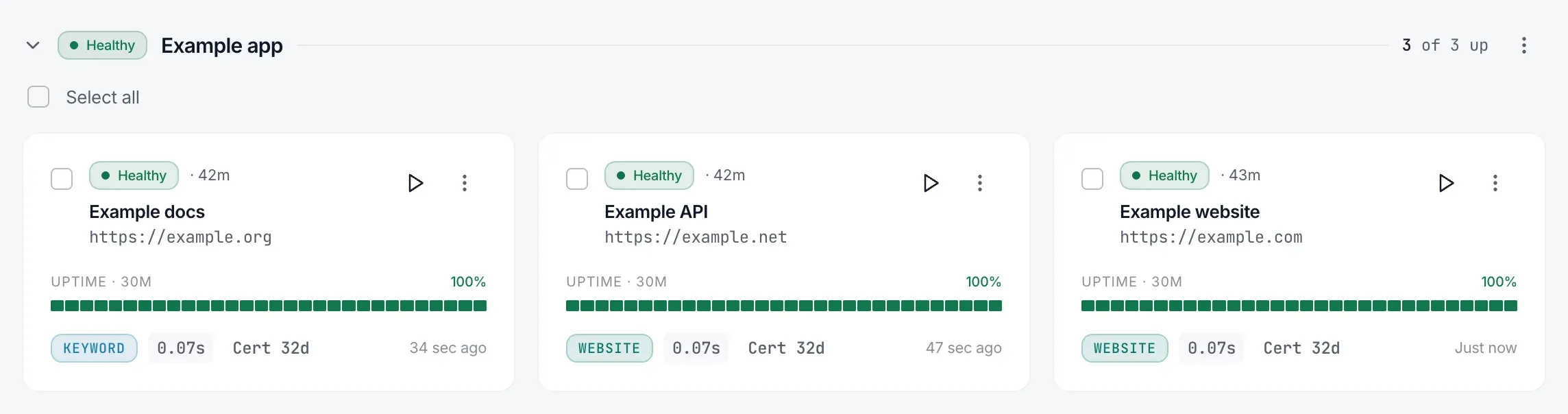
Each group’s header shows:
- The worst status among its checks.
- How many checks are up, as N of M up, counting only checks that aren’t paused, plus · K paused if any are paused.
- A menu with Rename group and Delete group.
Deleting a group keeps its checks. They move to Not in a group.
The Uptime page can list checks By group, By type, or with No grouping.
Tunnels and Uptime keep separate lists of groups: a check can’t join a Tunnels group, and a tunnel can’t join an Uptime group. Tunnel groups work the same way; see Groups in Working with monitors.